The spaces that define you

“Is he your first?”  “How many children do you have?”  “Does he have any brothers or sisters?”.  Innocuous questions.   Until you are grieving mother.  Then they become the questions you dread.  The questions that can leave you gasping, even when you have a well rehearsed answer.

“He is my third son,”  I answer with confidence and hope and pray no more questions follow.  But of course they do.  Because the natural thing to ask is how old.  To comment on  the chaos three little boys would inevitably bring.  And then I have to share Xavier’s story.   And suddenly a superficial exchange has been thrown somewhere entirely different.  Somewhere uncomfortable.  They make apologies.  I make apologies.   I have shifted in their eyes.  I have exposed a tender wound.  I have become to object of pity.

Before losing Xavier and learning a great deal about myself,  I used to think I had come to a place in my life where I was no longer jealous.  In my early twenties, as I watched friend after friend get engaged, jealousy consumed me in an entirely unhealthy way.  I believed that by the time I was thirty, I had let that go.  I watched dear friends build the houses of their dreams and I was so happy for them and surprised at my own lack of envy.  After Xavier’s death I learned some things about who I truly was.   I was not jealous, until they had something that I truly wanted and didn’t have – two living sons.  I did not tend towards jealousy, but I didn’t mind one bit if people were jealous of me.  In fact, I believe I courted it.   And to be object of the flip-side of that – to have people pity me.  To have people think “Thank God that wasn’t me”, was foreign and uncomfortable.   I am still not comfortable with it. And, at least in my mind, it is a natural reaction to Xavier’s story.

When someone learns for the first time that we lost a son to SIDS, I am thrown right back to the beginning again.  As they absorb what I have said, I watch their face change.  They have not accompanied me in the past year’s journey.  They don’t know where I am in this grief.   It has hit them anew, and I am taken back there with them.

I am proud to be Xavier’s mother.   I always will be.   I am happy to be defined as his mother.  I sometimes struggle to be defined as his grieving mother.    It feels like a terrible betrayal, but I am yearning for spaces in my life where I am not recognised as a grieving mother.  Spaces where I can pretend, even for a short while, that I am just as everyone else is.   People ask me how many children, and I find I am now being more evasive – “I have a four year old at home”.

But this presents me with a challenge.  Am I betraying a greater truth by not always proudly owning the mourning mamma persona?  Do I add to the taboo around talking about child loss?  Am I blindly perpetuating the myth that we are all happy, shiny people?  So often when I do open up about Xavier, people tell me something they are struggling with.  That window of opportunity would not exist without my first revealing my greatest hurt.

What is my responsibility to Xavier?  To the community of grieving hearts?  To the wider community? To my own soul and what I need?  How much do I always need to reveal?   I am still working through these questions.

But this I know – even as mother to living children, I need spaces aside from the mummy persona.  Spaces to create, to think, to be.   Recuperative space where I am nothing more or less than the bare bones version of myself.   And perhaps, this is what I yearn for when I say I need space away from being a grieving mother.

Myths about SIDS

Before Xavier died by SIDS, my knowledge of SIDS was limited to Red Nose day and the safe sleeping guidelines, particularly the emphasis on sleeping babies on their backs.  I, like most people, thought following the guidelines was preventive, rather than risk reductive.

Since losing Xavier, I have learned so much about SIDS, some of which I have included on this blog – About SIDS   There are a number of misunderstandings around SIDS.   It is my hope that by discussing these misunderstandings, people become better educated about SIDS and the ways that they can protect their babies.

SIDS cases are actually accidental suffocation
The guidelines reduce both the instance of SIDS and accidental suffocation but they are very different causes of death.   They present differently in autopsies.   In the case of SIDS, the baby has an underlying susceptibility to SIDS. The part of the brain that regulates breathing doesn’t work properly and when faced with a challenge to breathing that a non-SIDS baby would overcome, they cease breathing.   The guidelines aim to reduce the situations in which that challenge would occur.  In the case of accidental suffocation, the baby’s access to oxygen is cut off.   All babies are at risk of accidental suffocation.  Only babies susceptible to SIDS are in danger of dying by SIDS.  There is currently no way to identify that susceptibility.

SIDS no longer exists
The safe sleeping campaign has done great things and the rate of SIDS deaths has reduced by 80% since the introduction of the back to sleep campaign. Despite that, 80+ babies per year in Australia die by SIDS.  SIDS remains the leading cause of death of infants aged 1 month to a year.

In all SIDS cases, the parents haven’t followed the guidelines
There are a numerous cases where parents have followed the guidelines, and still lost their child to SIDS.
In addition, there are cases where the guidelines may not have been strictly followed, but in circumstances outside of a parent’s control.  There are cases of parents who have placed their baby to sleep on their back, and their baby has rolled onto their front in their sleep.  There are cases where babies have died in carseats and prams during afternoon naps whilst the family has been out.   The guidelines are incredibly important and have been proven to reduce the risk of babys’ dying by SIDS, but they do not offer 100% protection.

My baby is really happy and healthy – he wouldn’t die by SIDS
The majority of SIDS babies appear perfectly healthy before succumbing to SIDS.  Some suffer a slight respiratory complaint prior to succumbing to SIDS, but this often presents so mildly that it amounts to nothing more than an unsettled night.   Neither good nor poor health is an indicator of SIDS susceptibility.

I breastfeed.  I am very healthy. I don’t smoke, drink excessively or use drugs.  I am well educated.  My baby won’t die by SIDS
Unfortunately, this profile would fit every SIDS mother I know.  SIDS doesn’t discriminate and whilst breastfeeding and avoiding alcohol, drugs and cigarettes does reduce the chances of SIDS occurring, it doesn’t prevent it.

I use a baby breathing and/or video monitor, so my baby is 100% safe
Monitoring devices have become more easily accessible and that’s a great thing.  Breathing monitors, such as the Orricom and Angel-care monitors offer great peace of mind.  However, they do not replace the safe sleeping guidelines and it is vitally important to follow those guidelines whether using a monitor or not.  In many instances, SIDS is instant and even when parents have been immediately alerted to their child’s lack of breath, they have been unable to save them.  Monitors have no doubt saved babies in the past, but there are also cases where monitors have been used and babies have still died by SIDS.  If monitors were the sole solution to SIDS, they would be the number one safe sleeping recommendation.  They are not.  I think they are a great idea but they need to be used in conjunction with the safe sleeping guidelines.

A reminder of the guidelines

  1. Sleep baby on the back from birth, not on the tummy or side
  2. Sleep baby with head and face uncovered
  3. Keep baby smoke free before birth and after
  4. Provide a safe sleeping environment night and day
  5. Sleep baby in their own safe sleeping place in the same room as an adult caregiver for the first six to twelve months
  6. Breastfeed baby

Excellent information about SIDS is available through the SIDS and Kids website

The Narrow

Have you ever noticed how often we use words associated with death and dying when we describe how babies sleep?  Dead asleep, dead to the world, sleeping like an angel, out like a light, in another place, dead weight, gone, out to it, passed out.   People sometimes say these things when describing Elijah sleeping.  Then they realise and look at me with momentary horror as they register the meaning of their words.  It’s okay.  It doesn’t worry me too much.   But there is a reason we use those descriptors.   The space between a baby sleeping and a baby never waking is narrow.  Narrow in a way that terrifies me.

When Elijah is deeply asleep, his body still and his breathing almost undectably shallow, I panic.  I place my hand against his stomach until I feel sure that he is okay.  Even though I know what a baby without breath looks like, I am still terrified.  That moment that severs them from life is instant in most SIDS cases.   One moment of this earth and the next beyond it.   I imagine two lines branching out from single one.  Two lines travelling in very different directions, but at their origin, separated by only the slightest of degrees.  When Elijah is deeply asleep, it’s not a stretch to imagine him taking the darker of those two paths.

I used to say “babies bounce” and be part of the confident parenting brigade that espoused the deceptive toughness of newborns.  It’s conventional parental wisdom – you are afraid of breaking your firstborn and treat them like china.  You realise that they are tougher than they seem and relax on your second.  And it’s true – babies survive so much.  It’s hard to hear tales of babies surviving starvation, abuse, tragic accidents and medical difficulties when your own baby couldn’t even survive a nap.   I love a miracle story as much as the next person, but there will always be that lingering thought “where was my miracle?”    Why was Xavier the antithesis of a miracle? He had a 999 in 1000 chance of living and he did not.

When my first son, Isaac, was born I expected to feel an immense love. I had read enough to know that would happen. I was surprised by the ferocity of that love.  That feeling that I would not only take a bullet for my son, but that I would have no problem pulling the trigger if I needed to, to protect him.     That there was absolutely nothing I would not do for him.  A lioness with her cub.  When Xavier was stolen by SIDS, I had no chance to fight for Xavier.  We were given a day in hospital, which is so much more than so many SIDS families, but it was immediately clear that this was a chance to say goodbye. There was to be no fight.   There was no rollercoaster of “will he make it or not”. There was just a little life snuffed out.   He had no chance to change his world whilst he was a part of it.   He was here and then no longer here.   The space between those realities too narrow.   No space for me to squeeze between and save my son.   Two weeks.   A sliver of time, too short to seem of consequence.   And yet his impact is indelible.   He changed lives.  Mostly for the better, but now fear is written on my heart.

The chances of Elijah dying are narrow.   So close to zero that it would seem impossible.  But Xavier fell into that narrow crack, beyond all reason and sense.
As Elijah gets older, the smiles and gurgles more frequent, he feels more of this earth.   It feels as though his place is permanent.    And every time he wakes again in the morning, the gap between him and the unthinkable narrows.

Exercise and Happiness

I was never a particularly co-ordinated child and therefore my sporting and exercise involvement was limited.  But I remained slender, having inherited my father’s insanely speedy metabolism.   Throughout university I was truly skinny, subsisting on a diet mostly proffered by the vending machine and the cafeteria.  I took it as a source of personal pride that I could make a $3 potato scallop into a meal by the addition of salt and a free lemon wedge.  But my lack of any exercise meant I was “skinny fat” – slender with no tone.   As the years progressed I learnt, like many of us do, that I could no longer eat a whole pizza and expect none of it to stick.  A few years before Isaac was born, I discovered Pilates.  It was my kind of exercise – a focus on stretching and flexibility without any of that annoying sweating.   Whilst I was pregnant with Isaac, I did Pilates every second day and credited his easy birth to it.   I delivered Xavier just as easily, without the benefit of Pilates, and had to concede something to good genes and dumb luck.  After we lost Xavier, I decided to get fit.  Properly fit.   I had to channel my restless energy and there were a million reasons why fitness was the best option.  I invested in a personal trainer.  I learned how to do a proper squat, lunge, sit-up, push-up.  I did weights.  I did cardio.  I did not give up.  I pushed past a barrier I didn’t know existed.  As the repetitions got harder, I would dedicate the next one to Xavier, the next to Teddy, the next to Charlie, the next to Harry.   Sadly, there were no shortage of angelic motivators.

I started to feel strong.  In body and in mind.   I would often visit Xavier’s grave after a PT session – it was when I was emotionally the strongest.   I look back at photos of me in December of last year, I can see the difference fitness made – I see a tough kind of sadness in those photos.  A determined look of “I won’t let this beat me”.  When I fell pregnant I continued to exercise for a while, but it got too hard and my true end goal had been reached.   I never set a weight target.  My goal was to be healthy and pregnant.

Now, my mind turns to exercise again.  Elijah is nearly 11 weeks old and I have no more excuses.  My friends with babies are going through similar motivation – perhaps the spaces in our minds are freeing themselves up to allow the possibility of exercise. Something for ourselves.  Most likely the abrupt advent of bikini season has spurned us on.

I live in a city that values the outdoors and exercise.  Our council has provided free exercise programs through their active parks program – Active Parks.  I have attended two of the baby boot camp programs now.

Yesterday I attended one at a nearby park with Isaac and Elijah.  As my first foray into exercise after Elijah’s birth, I was hoping for some gentle stretches, some yoga perhaps.   I was instead treated to burpees, squats, lunges, sprints, push-ups, planks, mountain climbs and sprints. Isaac adored the sprinting, making each one a race that he graciously allowed me a head start (and I needed it).    Elijah was also a stellar exercise partner, waking only once at a point that I may have intentionally woken him in any case. “More lunges? I’d love to but, oh dear, baby’s awake and needs me”.  That was before one show-off started lunging whilst holding her baby.  The class culminated in a final jog, some stretches and the promise of being sore the next day.   I certainly felt the steps in our house last night.

Today I headed off for another session, just with Elijah this time.  It was a little easier – perhaps the content, perhaps my body had suffered it’s shock yesterday, perhaps I had a less intense work-out partner than Isaac.  With the sun at my back, my baby sleeping in his pram, I could feel both Elijah and Xavier present.  As I jogged past trees, dappled with sunlight, I thought of Xavier dancing beside me.  I could still dedicate this work out to him, but not in the grim determined way I did last year.    Instead, I can feel him near, whispering in the breeze, and feel a happiness that I thought had long escaped my life.  Because at the end of the day exercise does that – it makes you happy.

The burden of gratitude

IMG_7483

Elijah, like all babies, goes through periods of not sleeping, crying jags and general grumpiness.    On the whole, he truly is a “good” baby, but even good babies have their off days. Good  mothers have them too.

But I won’t tell you about those days. Not because I am trying to hide behind the image of a perfect baby and mother.  But because  it would seem too close to ingratitude.   When you are robbed of your child, you feel robbed of your right to complain about anything other than that loss.   How can I complain about transient things? Everything becomes insignificant in the face of such giant loss.  All other problems dwarfed.  And to complain about a child, the very thing that I lost, that would be an ingratitude too great.

Grief teaches you things.  Teaches you to to appreciate each moment.   You begin to understand the enormous privilege it is to bear and bring up a child.  You start to glimpse the compete preciousness of it all.  You meet those that are desperate to have a baby to hold in their arms, not just in their hearts.  And you realise, even though you have had the most horrible thing to occur, how truly blessed you are to have children.   You cannot help but wonder if you needed to lose in order to learn that lesson.  You hang onto appreciation as a kind of insurance.   If I am grateful for each moment, then Elijah can stay.  If I consciously appreciate every single second of him, I can protect him.  Conversely, if, for even a moment I lose sight of that, maybe he will be taken from me.  I must not complain.

After Xavier died I would see Facebook posts or hear whinges about babies that wouldn’t  sleep or were fussy.  I would wish, wish that were me.  I would wonder how people could be so blind.  I would vow never to be so unthinking.  But does the pendulum swing both ways?  Is all this thoughtful gratitude and gushing presenting an unrealistic image of life?  Am I expecting too much of myself and pressuring others?  Is it just as unthoughtful of me to be posting photos of a picture perfect, content baby all the time?

After all life does goes on and it continues to be challenging.   I wish that Xavier’s death had solved all my problems. All the problems of my friends and family.  But it didn’t.   Perhaps it offered some perspective, but it didn’t eradicate all other pain and it didn’t magically make our lives easy.

After Xavier’s death it took a little while before friends and family would once again discuss their problems with me.  I was glad when they did.  Glad that they thought my perspective would be useful.  Glad that they thought I could cope.  But I know even then they were careful not to complain, not to give any inference that they weren’t completely grateful for their blessings.

Perhaps the answer lies in living with grace, rather than finding limitless gratitude for every moment and a moratorium on complaints.  Living with the grace that I know no matter what life throws at me, I will handle it.  Living with the grace that I know I can see beauty, even in the darkness.  Living with the grace that problems still occur, to me and to others, and that listening and talking about those things doesn’t make me ungrateful.  It just makes me human.


What TO say to the grieving

When we lost Xavier, we were incredibly lucky with the support we received.   Very few people said “the wrong thing”.  And whilst I know most of our friends and family were lost for words,  we felt their support, their prayers and their love.  This is not everyone’s experience after losing a child.

There are plenty of excellent blog posts about what not to say to a grieving parent.   I wanted to talk about why these things are hurtful and some alternatives.    Grief is different for every single person, but at the same time there are commonalities about what gives comfort and what does not.   If you cannot find the right words, that’s okay – just say that rather than relying on trite platitudes.  The sweetest sound will always be my baby’s name.

At least you have your living child/ren.
A bereaved parent is highly aware of their blessings – it may be the only thing they are holding onto.  They don’t need you to point them out.  They did not gain those living children as part of this loss and those children are also grieving their sibling.  In addition, grief is time consuming and tiring work – it can make looking after other children very difficult.   The slack that would be given to a mother of a newborn baby is not afforded to a newly bereaved mother, even though she needs it just as much.
Instead say “I am sure that your living child/ren are a huge comfort right now but I can also see that you need to spend time with your baby and your grief.  Can I help you out by baby sitting?”

You can have more children.
Firstly, you don’t know this nor do you know what the parents have decided regarding have more children.  Secondly, it’s actually irrelevant.  This grief is about their child that has passed away – children are not replaceable or interchangeable.
Instead say “I am so very sorry that (say their baby’s name) couldn’t stay longer.  I will always remember him/her with you.”

It could have been worse – your husband / wife /older child might have died.
You play head games in grief.  You think of people you would  have rather lost than your baby.  Don’t second guess what the result of that horrible game might have been.  Besides, this comment is never going to be comforting to a person who is now suddenly terrified that loved ones can be snatched away  without cause or reason.
Instead say “I can’t understand why this happened to you.  It’s just not fair.”

There are in a better place / this happened for a reason.
This might be your belief.  But I can tell you now, the only person that gives comfort to is the person that hasn’t lost the child.  The best place for any child to be is in their parent’s arms and there is never a good reason for a child to die.  This just isn’t helpful and I think we only say it because someone taught us to say it when someone dies.  Perhaps it has it’s place when an elderly person dies, but not an infant.
Instead say “I don’t know how the world works and why such terrible things happen.  I wish your child was still with you and I will remember them always.”

It was only a miscarriage / thank goodness you lost them now, rather than when they were older.
There is no “only” in child loss.  Every person deals with things very differently and there is no right or wrong.  There are no measures in child-loss grief, there are just different circumstances and the same aching longing to hold our babies.  If you have children, ask yourself – would you prefer to lose them now or later on?  It is an impossible question and trying to answer it gives no comfort.
Instead say “I am so very sorry for your loss.  I am here if you need me.”

I couldn’t get out of bed in the morning / I couldn’t be as strong as you are / The Lord only sends you as much as you can survive – you must be so strong.
The truth is, if this happened to you, you would be getting out of the bed in the morning. You would be trying to make things work.  Your family and friends would still need you.  Your heart and head would have stopped and life would keep moving around you.  Whilst it is probably not what you mean, when this is said to a grieving parent they can hear the intimation that the speaker loves their baby more – that the loss of their baby would render them incapable and therefore their love must be greater.   Strength comes to you because you need it, not because it existed prior to loss.  Extra pain is not allotted to those with extra strength.
Instead say “The days must be really difficult and I want to help you.  When can I bring dinner around for you?”

My sister/friend/mother/aunt lost her baby, and she didn’t carry on this way.  You need to get over it.
Every grief journey is different.  Some are intensely private and you actually wouldn’t have a clue what their heart really looks like.  Others need to express their pain publicly.  Some have never been allowed to express their grief.   The pain of losing a child doesn’t go away, it dims with time but often flares up.  A bereaved parent will need to talk about their child.  Will have bad days, even years after loss.  A grieving parent learns where their grief is accepted and where it is not.  You need to decided which kind of friend you want to be – the one that can live with the discomfort and be there, or the one that would prefer  your grieving friend wear a mask for your benefit.  Think about why you want them to “get over it”.  Do you just miss the person that they used to be or are you genuinely concerned for your friend’s emotional wellbeing?  If you are concerned about their wellbeing, then you need be there for them.  Whatever that might look like.
Instead say “I know that you will miss (say their baby’s name) forever.  Do you want to talk about her/him?”

If you are genuinely concerned that their grief is overwhelming them to a point where it is unhealthy – that is they aren’t taking care of themselves or their family or they seem suicidal, say,

“I know you will miss (say their baby’s name) forever.  I miss them too. I am worried about you.  Is there anything I can do to help?  Do you want to talk? ”    

Educate yourself and contact your nearest SIDS and Kids.  They have counsellors who are experienced in consoling the grieving and they can help you understand what your friend needs and how you can help.

Ever since you lost your child, I have been terrified of losing mine.  Being around you makes me uncomfortable. 
Fortunately, child loss isn’t contagious.  But you do feel terribly, terribly alone.  Having people move away from you because they see their worst fears realised in your life adds to that isolation.  It is natural to fear something that has suddenly become real in your world, but that’s something you need to deal with – not the parent that has lost their child.  Think about the level of your friend’s discomfort and compare it to your own.  It’s not that bad is it?
Instead say “I am so very sorry that (say their baby’s name) isn’t with you.  They should be in your arms.  Please let me know if being around my baby/bump makes you uncomfortable. “

I don’t pretend it’s easy to find the right words.  I don’t pretend it’s easy to go out of your way and really help the grieving.  I don’t pretend that it’s easy to step out of your comfort zone.   But, at the end of the day, if you think any of it’s really hard, it’s nothing compared to losing your child.

What to wear after the bump

You have spent months dressing your bump, showing it off and basking in your pregnancy glow.   Now, I dearly hope you have your baby in your arms and are faced with a new set of sartorial challenges – how to dress your post-pregnancy body and, if breast feeding, how to make the milk bar accessible.

However, I know there will be those reading this that have given birth and are holding their precious child in their hearts rather than their arms.  When we lost Xavier to SIDS two weeks after giving birth, fashion was the last thing on my mind, but I did have to get dressed every morning.   I couldn’t bear to wear any of my maternity clothes, but my stomach had yet to reduce to its normal size.  I bought a couple of very cheap jeans at our local supermarket that also stocks clothes (Mix by Coles).  I couldn’t face clothes shopping, but I could just manage grabbing a few things with the groceries.  I also bought a few things online.  Even though I love shopping, the sight of racks and racks of clothes confused and saddened me.   My love of shopping has returned and I can still spot a bargain from a mile away.  The things you enjoy will come back, but it will take a little while.  In the mean time, do what you need to do to get through.

When pregnant your uterus expands to up to 500 times it’s usual size!  That’s a lot of growth and you do need to allow time for it to contract again.  Usually, this takes six weeks.  That’s just your uterus – it takes longer again of course to lose the baby weight itself.  So, no-one is walking out of the hospital in their pre-pregnancy skinny jeans and your maternity pants aren’t quite finished yet.   Those gorgeous dresses that showed of your burgeoning bump probably aren’t quite as flattering now that your baby is born and you have to learn a whole new way of dressing.

Here are my post-baby fashion tips:

  • Don’t be too hard on yourself or your body.  It has just achieved the most amazing feat of all.  You don’t need to subscribe to the celebrity trend of a concave stomach within three months.  They achieve that through countless hours in the gym.  Countless hours that they aren’t spending with their baby.
  • Particularly if your are a first time mother, you and baby are both learning and that’s not easy.  PJ days are inevitable.  So just invest in some lovely PJs that you feel comfortable answering the door in.   Lounge or light weight track pants with a maternity singlet or top are perfect. Intimo have some beautiful loungewear.  It’s not cheap, but it does last.
  • The tops you wore in early pregnancy that skimmed over your bump, rather than showing it off are perfect for this time.
  • Scarves are wonderful things.  Worn over nursing singlets they hide the post-baby bump.  They add colour to an outfit.  They make nursing singlets look less like underwear. They offer a modesty cover if you want it when breast-feeding.   They can double as spit-up cloths.  Maybe don’t wear your Hermes.
  • Babies spit-up.  Babies do number 3s.  My Baby is a master of the ninja wee.  Somehow I am wet, and he isn’t.  Basically, you are going to get dirty.  Keep your clothes practical and washable.   Darker colours and patterns are great at disguising spit-ups.   You know to keep a few changes of clothes for baby in your bag – keep a change of clothes for yourself also.
  • It is easy to become lost in your baby.  Taking a little time out to make yourself look and feel nice is okay.

And if you are breastfeeding:

  • You will either breastfeed by unbuttoning/unzipping/pulling down your top or lifting it up.   Lifting up your top is probably more modest in terms of revealing your breasts.   Most women probably don’t want to bear their tummy flesh when feeding, so a good option is to wear something light and flowy over the top of a nursing singlet.
  • I am completely un-coordinated with the lift-up method and Elijah normally gets caught up in material.  Ditto when I try to use a breast feeding cover.  I tend to do the pull down method.  This means I either wear low cut tops with a bit of stretch to them, or button/zip down tops.  In order to preserve some modesty, I will often pair a singlet with a jacket or cardigan which covers the boob when feeding.  Again, a scarf can be useful here.
  • I am fortunate to have a lot of milk.  This means a lot of leakage.  This means breast milk getting all over my tops.  One way to circumvent this is to invest in a few newborn bibs that will hopefully absorb the milk.
  • You will find that the first few times you breastfeed in public you are hyper-aware and thinking everyone is looking at you. They most probably aren’t.  The most important people in the breast feeding equation are you and your baby.  As my gorgeous, uninhibited, Brazilian friend once put it “I got enough to worry about – I don’t need to worry about what people around me think.”  However, if nursing in public does stress you out – it will also stress your baby out.  Invest in a light-weight nursing cover.
  • Your boobs are doing a lot of work.  Treat them kindly and ensure you wear supportive bras.   Bonds do a great line.
  • As in pregnancy, don’t change your style completely – you will never get out of the house for lack of things to wear.  I don’t normally wear button-down collared tops and trying to adopt them for breast feeding just doesn’t work for me.
  • Just as I advised during pregnancy, put away the things that don’t fit or work for this time in your life.  It will make getting ready so much easier!
  • You probably feel like you will never get back to your usual wardrobe again.  Keep in mind that the period of time when a baby feeds every 3 – 4 hours is limited.  Even if you intend to breastfeed past 6 months, there comes a time when babies just feed in the morning and evening.  Your wardrobe will open up again then.

My nursing kit

  • Wrap dresses – perfect for feeding.
  • 5 nursing singlets in black, white and nude.  Bonds do great ones.  Kmart and Target also do and they are a bit cheaper.
  • Jackets, capelets and/or cardigans.
  • Comfy pants (maternity or elasticated).  Elasticated harem pants are great if you don’t mind getting your hippy on.  Try Tree of life.
  • Loose, flow-y tops.
  • Zip-down tops
  • Stretchy, low cut tops

image1xl Love this  top from ASOS  (click to go to)

DSC01743 DSC01744 DSC01745 DSC01748

Some of my nursing essentials

What to wear when you are expecting

I don’t want this blog to be completely earnest and lacking in any frivolity, so today I thought I’d write about maternity fashion. I thought I’d also like to wrote a post that didn’t result in tears.

Pregnancy offers up a unique set of sartorial challenges – from the early stages when your belly looks more “big lunch” than “big news” to the last few weeks when nothing fits but buying anything new seems pointless.

I won’t pretend to be the most stylish lady in the room – I leave that honour to my friends and gorgeous sister in laws. But I do love clothes and after being pregnant for the better half of two years, I think I started to get it right. I adored my pregnancy with Elijah. Whilst it was beset with anxiety I also recognised it as my last pregnancy and wanted to enjoy every bit – including dressing bump. This has now evolved into being excited about dressing Elijah each morning and frustration over breast-feeding fashion. But that’s for another post!

Here are my tips:

  • Invest early in maternity pants that will see you through the pregnancy (and beyond). You can get away with non-maternity tops, but you need comfy bottoms. In early pregnancy, you can use a belly band to keep them up if they are on the big side. ASOS maternity offers some great options and seems to be the only place on earth where their maternity wear is actually cheaper than the standard gear. Their sizing in maternity is generous around the belly but weirdly tight around the arms and legs. Maybe UK ladies don’t get water retention!
  • Accessories are your best friend – keep them bright and funky. Wear those statement earrings – their days are numbered!
  • Black is definitely a great and easy option, but if you do wear all black, add a pop of colour with some jewellery, scarf or jacket. This is a joyous time after all and colour will lift your mood.
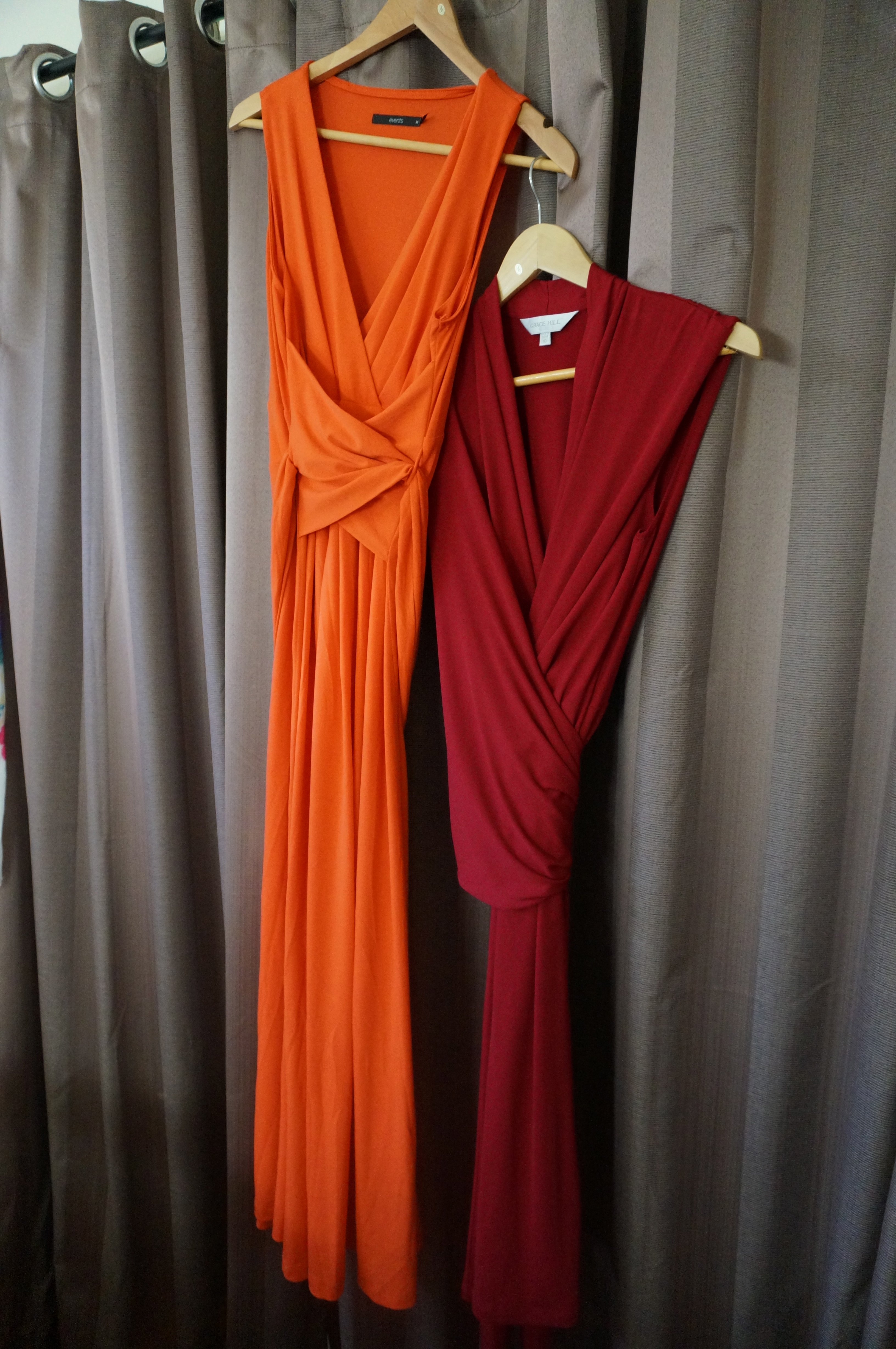
  • Jersey wrap dresses (they needn’t be maternity) are perfect for the office with a growing bump and will also work for breastfeeding afterwards. Leona Edmiston has some beautiful options and for a less expensive option, Ezibuy generally has a few wrap dresses amongst their collections.
  • Show off what remains slender. Whilst my arms lost tone, my legs remained relatively slim – so I favoured tights and loose tops.
  • In the early weeks when it’s not obvious you are pregnant, opt for tops that skim over your belly rather than show it off. These will also be useful in the months after having baby.
  • Go through your wardrobe every couple of weeks and put away what ever no longer fits. It will make getting ready so much easier. When you do this, keep your buttoned down shirts, looser blouses and other tops you can breast feed in, in a different pile so you can get to it easily after bub is born.
  • Invest in a few long singlets for layering. As your belly grows, tops that used to work over tights will start to ride up. I am a card carrying member of the “tights are not pants” club and believe that bottoms should be covered. Having very long singlets allowed me to wear them underneath my existing long tops and still wear those comfy tights with dignity.  Glassons has singlet options at good prices. Lower cut tops will have the added advantage of showing off your new cleavage and offering some more options if you breastfeed.
  • Use belts under the bust to accentuate your bump. Your normal belts may no longer fit, so raid your partners. You might want to grab one of his white shirts while you are it – also great for a growing belly.
  • Don’t spend too much on “bump” dresses. They are certainly gorgeous, but they are a late pregnancy only item. Don’t fall into thinking you will wear them after baby. You probably won’t.
  • You may get thoroughly, thoroughly sick of the clothes you wear during pregnancy and never want to see them again once baby is born. Don’t break the bank!
  • Don’t change your style completely when pregnant – you will feel uncomfortable. It’s better to adapt your usual look to something that works with pregnancy.
  • To avoid tears and stress in the morning (at least as they relate to what to wear), plan outfits in advance.
  • On those days when you are just over it, take a moment, breath, connect with your baby and think of all the cute outfits you will be dressing them in soon.

My essential kit (I was pregnant during winter)

  • Jersey dresses (particularly if you are working)
  • 2 pairs maternity jeans
  • 2 – 3 pair tights (leggings)
  • 1 pair black trousers
  • 3 long singlets
  • Tight dresses to show off your bump
  • Belly band
  • Long tops with space for belly
  • Jackets and vests
  • 2 pairs of go with anything flats. Weirdly, very neutral and very out-there tones seem to work back with most things. I absolutely flogged a pair of gold glittery ballet flats.
  • I think it’s nice to buy a new pair of PJs for going into hospital

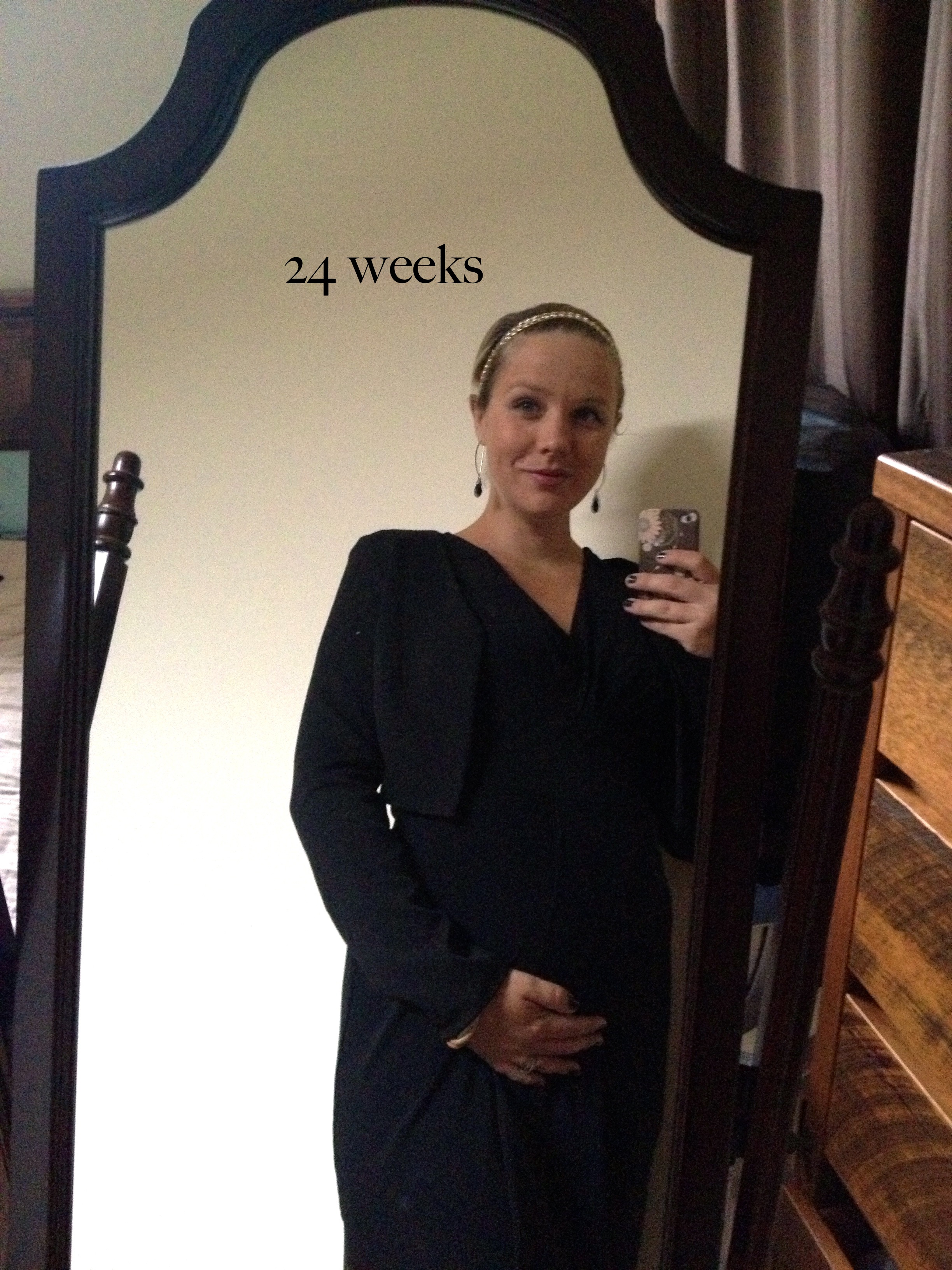
Here are a few of my favourite looks from pregnancy (I was a bit obsessive about recording the bump for posterity and I apologise for the bedroom mess)

IMG_5144 IMG_5148 IMG_5259 IMG_5314 IMG_5517 IMG_5858 IMG_5901 IMG_5972

IMG_4564

Right now I am struggling with a new sartorial challenge – what to wear breast feeding. More on that later!

The Inside and the Outside

20130926-102310.jpg

Every Saturday my little family heads down to the local coffee shop and I wonder what we look like to other people. Beautiful four year old running at the front of the pram, cute little Hugo, our cavalier puppy, on his heels. N or I pushing the pram, lightly touching each other around the waist. It must look idyllic. It must look like the perfect family. What it looks like and what it is are so very different.

I felt similarly when pregnant. I wondered if people who had recently suffered loss or infertility looked jealously at my growing bump.

I know in the weeks after Xavier died I wanted to rush up to mothers of newborns and say “Do you know? Do you know how utterly privileged you are?” I wanted to talk to those heavily pregnant and ask “Do you know? Do you know the precious weight of what you carry?” I didn’t of course. But what if I had and she had returned the pain in my own eyes. If she would have said, with a heaviness another loss mother would recognise, “Yes”.

We go about our daily battles and it seems like everyone else’s battles are being easily won. But we don’t know. We don’t know how much pain lies before apparent happiness. Each of us are icebergs, only revealing the tip of our lives. Carefully constructing the image we allow the world to see. We know this of ourselves – why do we presume that everyone around us does any differently?

My personal Facebook feed is filled with photos of Elijah on different outings – parks, various beaches, numerous cafes. As my parents are currently overseas, I am posting daily pictures so they can watch him grow. This no doubt gives the impression of a terribly confident mother – happily out and about with a perfectly behaved newborn. This would be a generous assumption. In truth, I am not a homebody and will always prefer out to in. When I am at home alone with Elijah, the darker thoughts creep in. It’s when I hold him close and beg him not to die. Do I prefer the facade of a mother breezing through parenthood? Of course, but it masks a darker truth.

I never want to be defined by my loss – although I am happy to be shaped by it. But sometimes, I want to scream “Getting here wasn’t easy – the road to this seeming perfection was paved with tears and still, always, there is someone missing”.

But that’s not the image I have chosen to present to the world. There is a large element of choice here. Could I fall apart? Of course I could, in a heartbeat, in an instant. But I hold myself and my family together. Is this a form of lying? Would it be truer to myself to let more of the pain show? Would it ease the pressure on those around me if I was to be more “real”? I am not sure. So much of how I coped with Xavier’s death was “fake it until you feel it”. When faced with something that cleaves your heart in two, people really don’t want to see the full ugliness of it. I didn’t want to be the full ugliness of it. For all our talk of being real, there comes a point of too real. And so I have been play-acting for some time now. Not just for those around me, but for me. I have been play-acting for so long that it might be difficult to tell where the reality and where the acting meet. And perhaps this simply is my new reality.

Being grateful for each and every moment, striving to live in the now and taking advantage of every possibility can seem unbearably Pollyanna-ish. It can seem fake and impossible. But my alternative is impossible and so I take this path and I will smile through the pain.

Dear Mummy

I have had a rough week. Plagued by doubts about my ability as a mother. Many episodes of being convinced that Elijah will die. Watching each breath as though its his last. Missing Xavier more acutely as I am reminded exactly of what I missed and time takes Elijah further away from Xavier’s little life.

When it all gets too much, I imagine what Xavier might tell me if he could.

Dearest Mummy,
I have seen you struggle these last few days. Seen the tears fall and wished I could wipe them away.

When you watch over Elijah, so convinced this breath will be his last, I am watching over him too. I promised to keep him safe. Trust.

Why do you think yourself a poor mother? You have been told so many times you could not save me. You have been told so many times you are a good mother. Those that you know that have suffered loss, those you have cried with, do you judge them poor parents? Do you think them anything but beautiful and wonderful parents? Turn some of that kindness to yourself. You are a good mother. Believe.

I know you hold him in your arms and ache for me. I know that having a newborn has made what we missed so much more real. I know that connecting on a spiritual level comes a poor second to touching, kissing, breathing in sweet baby scent. I wish things could have been different too. But this is what we have. And I need you to still nurture it. I still need you. Love.

These days shall pass. Too quickly. Enjoy them. Enjoy the moments that will eventually draw us together again. Cherish.

I love you mummy.